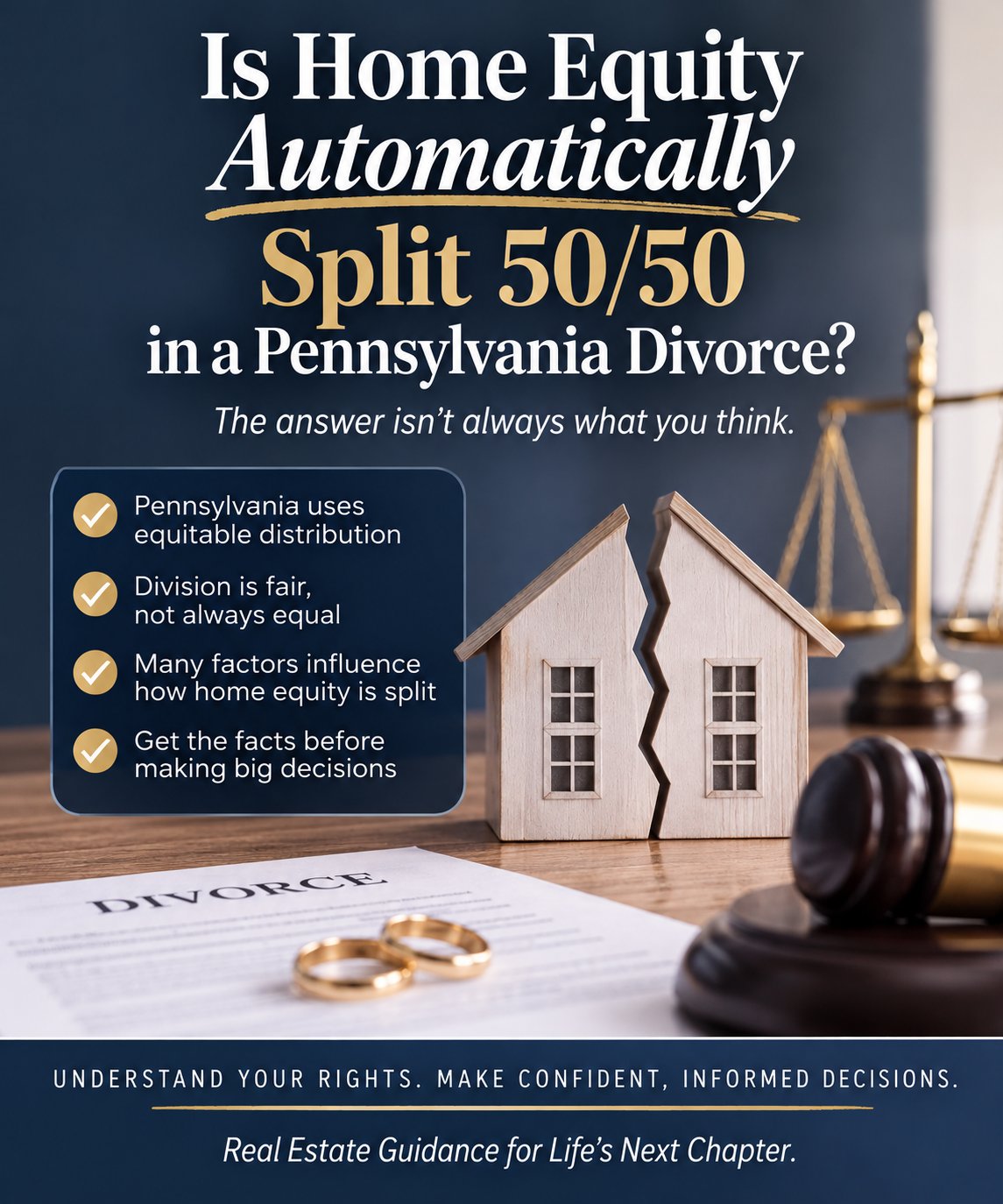
Does Pennsylvania Split the House 50/50 in a Divorce?
No. This is one of the most common misconceptions in Pennsylvania divorce, and it trips up homeowners because "fair" and "equal" sound like the same thing. They aren't, and the difference can significantly change what each spouse actually walks away with.
Pennsylvania Is an Equitable Distribution State, Not a 50/50 State
Pennsylvania law provides for the equitable division of marital property, considering multiple statutory factors. That means equitable does not automatically equal an exact 50/50 split. Under 23 Pa.C.S. § 3502, courts are directed to divide marital property in whatever percentages and manner the court deems just, after weighing all relevant factors, without regard to marital misconduct. A judge can, and often does, apply different percentages to different assets, rather than splitting everything evenly down the middle.
That's a legal question for a family-law attorney. It depends on the specific facts of the marriage, and it's decided under a statute with real teeth, not a rule of thumb.
What the Law Actually Weighs
Pennsylvania's equitable distribution statute lists thirteen factors relevant to how marital property gets divided, including:
- The length of the marriage.
- Any prior marriage of either party.
- The age, health, income, vocational skills, employability, and needs of each spouse.
- The contribution by one spouse to the other's education, training, or increased earning power.
- Each spouse's opportunity for future acquisition of capital assets and income.
- Sources of income for both spouses, including retirement, insurance, or other benefits.
- The contribution, or dissipation, of each spouse toward acquiring, preserving, or growing the marital property, including as a homemaker.
- The value of property already set apart to each spouse.
- The standard of living established during the marriage.
- The economic circumstances of each spouse at the time the division becomes effective.
- Tax consequences associated with each asset being divided.
- The cost of selling, transferring, or liquidating a particular asset.
- Whether a spouse will be the custodian of a dependent minor child.
That's a lot of moving parts, and it's exactly why the outcome varies from case to case. A 30-year marriage with one spouse who left the workforce to raise children looks nothing like a five-year marriage with two full-time working spouses, and Pennsylvania's statute is built to weigh both differently.
Where a Realtor Fits In, and Where We Don't
This is where the real-estate professional's role gets clearer, precisely because it's narrower than people expect. The real-estate professional's role is different from the attorney's. We can help answer one specific question: what could the property reasonably sell for in today's market?
That matters because you can't intelligently discuss home equity without first understanding value. Everything downstream, the negotiation, the buyout number, the settlement conversation, depends on having an accurate starting figure.
A Simple Example
Here's how that plays out in practice:
- Estimated market value: $650,000
- Mortgage balance: $350,000
- Gross equity: roughly $300,000
That creates roughly $300,000 in gross equity before considering additional property obligations or transaction considerations, things like closing costs, agent commissions, capital gains exposure, or any liens against the property. That $300,000 figure is a starting point for a conversation, not a distribution outcome.
How that equity ultimately factors into the marital-property settlement is a legal matter. The value itself is a real estate question. What percentage of it either spouse receives, and whether it's offset against other assets, is governed by the thirteen factors above, and that's squarely an attorney's call.
Why This Distinction Actually Matters
A Realtor should not determine what someone is legally entitled to receive. An attorney shouldn't have to guess what a buyer would actually pay for a house. Both professions require years of specific expertise, and neither substitutes for the other, no matter how confident either party feels about crossing the line.
When a Realtor starts opining on legal entitlement, or an attorney starts estimating market value without current data, the homeowner ends up with worse information than if each professional had simply stayed in their lane. The best decisions happen when each professional stays in their lane and the homeowner gets reliable information from both.
How to Use This in Your Own Divorce
- Get a professional market value estimate early, so the equity conversation starts from real numbers instead of guesses or outdated online estimates.
- Bring that number to your attorney, and let them apply it against the statutory factors relevant to your specific marriage.
- Don't ask your Realtor to predict what a judge will decide, and don't ask your attorney to price your house. Use each professional for what they're actually trained to do.
- Revisit the value if there's a significant gap in time between the initial estimate and when the settlement is finalized, since markets move.
The Bottom Line
Pennsylvania divorces are governed by equitable distribution, not a 50/50 rule, and the statute weighs thirteen separate factors to determine what's fair in each specific marriage. A Realtor's job is to answer the market value question accurately. An attorney's job is to translate that value, along with everything else in the marriage, into a fair legal outcome. Keeping those roles separate, and using both, gives homeowners the clearest possible picture before decisions get made.
FAQ: Pennsylvania Equitable Distribution
Does Pennsylvania split marital property 50/50 in a divorce? No. Pennsylvania is an equitable distribution state under 23 Pa.C.S. § 3502, which means courts divide marital property fairly based on statutory factors, not automatically in half. A judge can apply different percentages to different assets.
What factors does a Pennsylvania court consider when dividing property? Pennsylvania's equitable distribution statute lists thirteen factors, including the length of the marriage, each spouse's age, health, income, and earning capacity, contributions to the marriage including as a homemaker, tax consequences, and whether a spouse will be the custodian of a dependent child, among others.
Can a Realtor tell me what percentage of the house equity I'm entitled to? No. A Realtor can estimate what the property could reasonably sell for in today's market, which establishes the equity available to divide. What percentage of that equity either spouse ultimately receives is a legal determination made under Pennsylvania's equitable distribution factors, and that question belongs with a family-law attorney.
How is home equity calculated for a divorce settlement? Home equity is generally the estimated market value of the property minus the outstanding mortgage balance. For example, a $650,000 market value with a $350,000 mortgage balance creates roughly $300,000 in gross equity, before accounting for selling costs, liens, or other transaction considerations.
Is marital misconduct considered when dividing property in Pennsylvania? No. Under 23 Pa.C.S. § 3502, Pennsylvania courts divide marital property without regard to marital misconduct. The statute focuses on economic and practical factors rather than fault.
Related Reading
Best Selling Options in a Divorce (free guide)
Can You Buy Another House Before Your Divorce Is Final?
How Do You Determine What a House Is Worth During Divorce?
What Happens When One Spouse Wants to Sell the House and the Other Doesn't?
Does Taking Your Name Off the Deed Remove You From the Mortgage?
Should You Sell the House Before or After the Divorce Is Final?
What Happens to the Mortgage After Divorce?
Sources
- 23 Pa.C.S. § 3502, Equitable Division of Marital Property — https://www.legis.state.pa.us/WU01/LI/LI/CT/HTM/23/00.035.002.000..HTM
- Justia, 23 Pennsylvania Consolidated Statutes § 3502 — https://law.justia.com/codes/pennsylvania/title-23/chapter-35/section-3502/
- Cornell Law School, 23 Pa. C.S.A. § 3501, Domestic Relations - Property Division — https://www.law.cornell.edu/gender-justice/resource/23_pa.c.s.a.%C2%A7_3501_domestic_relations_-_property_division
About the Author
Aubre Stacknick is a Global Real Estate Advisor with Piatt Sotheby's International Realty, serving Pittsburgh and the surrounding area. With 20+ years across construction, custom home building, and real estate, and having navigated divorce herself, she brings a practical, firsthand understanding of both the financial and emotional sides of buying, selling, or holding property through a divorce.
📞 412-721-3496 📧 [email protected] 🌐 www.aubrestacknick.com
Curious what your home is worth in today's market? Get a free home valuation and find out where you stand.
Pennsylvania equitable distribution, is divorce 50/50 in PA, home equity divorce, 23 Pa.C.S. 3502, divorce real estate Pittsburgh, marital property division Pennsylvania
This blog is for general informational purposes only and is not legal or financial advice. Confirm your specific situation with a Pennsylvania family-law attorney.